




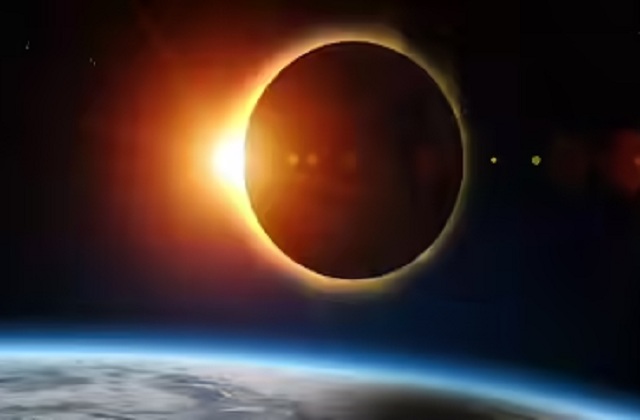
Surya Grahan 2026: In Sanatan Dharma and Vedic astrology, a solar eclipse holds special significance. The first solar eclipse of 2026 will occur on February 17, 2026. This will be an Annular Solar Eclipse, commonly known as the “Ring of Fire.” However, this celestial event will not be visible in India, and therefore, the Sutak Kaal will not be observed in the country.
When and How Will the Solar Eclipse Occur?
According to astronomical calculations, the eclipse will take place on Amavasya (New Moon) day, February 17, 2026. The timing as per Indian Standard Time (IST) is as follows:
- Start: 3:26 PM
- Maximum Eclipse: Around 5:40 PM
- End: 7:57 PM
The total duration of the eclipse will be approximately 4 hours and 32 minutes.
During a solar eclipse, the Moon passes between the Earth and the Sun, partially blocking the Sun’s light. In the case of an annular eclipse, the central portion of the Sun is covered, leaving a bright ring-like outline visible around the Moon — hence the term “Ring of Fire.”
From an astrological perspective, this eclipse is considered significant because the Sun will be transiting in Aquarius (Kumbh Rashi) at the time.
Will Sutak Kaal Be Observed in India?
According to religious beliefs, the Sutak Kaal begins 12 hours before a solar eclipse. During this period, performing religious rituals, opening temple doors, and undertaking auspicious activities are generally avoided.
However, scriptures also state that if an eclipse is not visible in a particular region, the Sutak period is not considered valid there.
Since the February 17, 2026 solar eclipse will not be visible in India, Sutak Kaal will not be applicable, and regular religious activities can continue without restrictions.
Where Will the Eclipse Be Visible?
The annular solar eclipse will primarily be visible in the following regions:
- South Africa
- Zimbabwe
- Zambia
- Tanzania
- Mauritius
- Antarctica
- Parts of South America, including Argentina and Chile
People in these regions will witness the spectacular “Ring of Fire” phenomenon.
Astronomical and Astrological Significance
From a scientific perspective, a solar eclipse is a natural astronomical event caused by the alignment of the Earth, Moon, and Sun.
In astrology, however, eclipses are often associated with planetary influences. Many people consider this time favorable for charity, meditation, and mantra chanting, believing it enhances spiritual benefits.






Leave feedback about this